Festival drug checking in Europe 2026: country-by-country guide to testing your substances
A practical 2026 map of where you can actually get drugs tested before a festival across the EU and UK. DIMS, The Loop, Energy Control, checkit!, Saferparty, Modus Vivendi, HSE, and what circulates this summer.

Festival season is starting again. The first weekenders are loading up the car for Pinkpop, Hellfest, Primavera, We Are FSTVL, Awakenings — and a few weeks later, Tomorrowland, Boomtown, Sziget. Across Europe, harm-reduction services are about to put their tents up. Some of those services will save lives this summer. Others are illegal where you live. The line between the two is geographic, and most festival-goers cross a border without knowing what changes underneath them.
This guide is a country-by-country map of where, in 2026, you can actually get drugs analysed — at a festival, on the way to one, or by post a few weeks ahead. It covers what's circulating in the European supply right now, what to take with you, and what to do when something goes wrong. It is the article we wished existed when we started volunteering on tents in Sweden and the Netherlands ten years ago.
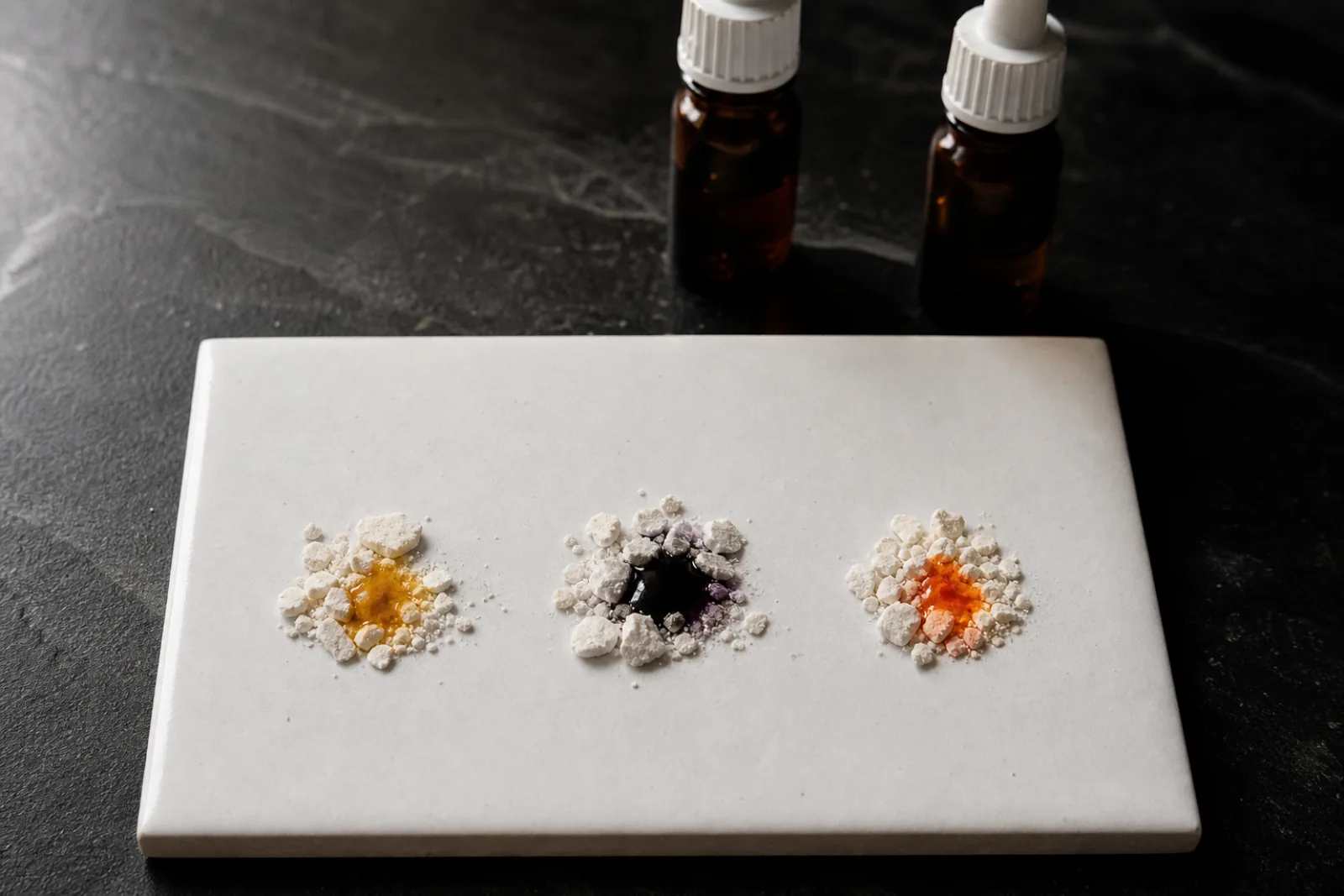 A Marquis, Mecke and Mandelin reagent test on a presumed-MDMA sample. The deep purple-to-black Marquis reaction in the centre is the qualitative MDMA signal — reagent colour cannot tell you the dose. For that you need a chromatographic lab.
TL;DR
- The Netherlands, Switzerland and Austria have the best front-of-house drug checking in Europe in 2026. Free, anonymous, and embedded in regular services. If you can travel, send a sample weeks ahead through one of them.
- The UK is shifting. The Loop now runs monthly front-of-house clinics in Bristol, Hackney and Camden (licensed by the Home Office). At festivals they only run back-of-house testing, which means you cannot submit your own pill at the gate but the data still feeds same-day warnings on the festival app.
- Spain (Energy Control), Belgium (Modus Vivendi), Portugal (Kosmicare), Ireland (HSE Safer Nightlife) all run free analysis at major festivals. Spain and Portugal also accept postal samples from abroad — €50 to €60 a sample, results in about a week.
- Germany, France, Italy and most of Eastern Europe still have no national service. Workarounds: postal submission to Energy Control or Saferparty, plus a Marquis–Mecke–Mandelin reagent kit in your pocket.
- What is circulating this summer: MDMA pills routinely in the 200–320 mg range, occasional PMMA/BMDB, nitazenes in counterfeit Xanax and oxycodone, 2F-DCK being replaced by 2F-NENDCK with zero human safety data, and synthetic cathinones surfacing again in MDMA crystal.
What "drug checking" actually means in 2026
Three distinct things sit under the same label and you should know which you are getting before you queue.
Front-of-house (FOH) drug checking — you walk up to a tent, hand in a small sample of what you intend to take, answer a short anonymous questionnaire, and get the result back. Either on the spot (mobile lab, ~60 minutes), the next day, or by post a week later. You also get a short consultation with a peer worker or healthcare professional. This is what DIMS, Energy Control, checkit!, Saferparty and Modus Vivendi do.
Back-of-house (BOH) drug checking — substances confiscated by security, surrendered into amnesty bins, or handed in after medical incidents are tested by an on-site lab. Results are not returned to the original user (you do not get your pill back) but they feed into real-time warnings broadcast on the festival app, screens, and social. This is what The Loop currently does at UK festivals, and what some Dutch and German services do in parallel with their FOH work.
Reagent / strip testing — a colour-change reagent or a single-target lateral flow strip you do yourself, in your tent or hotel room. Cheap, immediate, qualitative ("is it MDMA?", "does it contain fentanyl?"), but blind to the dose. Not a substitute for FOH, but a real upgrade over "trust the seller". See our reagent kit guide and how to test MDMA at home.
Only the first one tells you the dose. Only the first one can warn you "your pill contains 285 mg and is more than double a normal first-time dose for your weight". This is why a lot of people travel for it.
Country-by-country, what 2026 actually looks like
Netherlands — gold standard
Service: DIMS (Drugs Informatie en Monitoring Systeem), coordinated by the Trimbos Institute. Live since 1992. A national network of ~33 drop-in locations, run by Jellinek, Brijder, Tactus, Novadic-Kentron, IrisZorg, Mondriaan, VNN and others.
How it works: Walk in during open hours (typically one or two evenings a week per location), submit your sample, fill in an anonymous form. Pills you can often get an on-the-spot match against the DIMS database; novel substances go to the Trimbos lab in Utrecht and a full GC-MS quantitative result comes back in 1–2 weeks.
Cost: Free. Funded by the Ministry of Health (VWS).
What they test: MDMA pills and crystal, cocaine, ketamine, 2C-B, LSD, amphetamine, GHB, 3-MMC, and most research chemicals. Cannabis is not part of DIMS. 3-MMC submissions doubled between 2022 and 2024 and are now the third most common drug DIMS sees, after MDMA and cocaine.
Festival presence: Unity (the prevention arm of Jellinek) is on the ground at every major Dutch festival — Awakenings, Mysteryland, Lowlands, Defqon.1, Decibel, DGTL, Pinkpop. They run an information stand, hand out earplugs and reagent kits, and feed real-time warnings into their Instagram (@unity.harmreduction) and the live drugs-test.nl red list. FOH testing at the festival itself is rare; you are expected to have used a DIMS drop-in beforehand.
Postal submissions: No. DIMS requires in-person hand-in at a Dutch test point. If you live in the Netherlands or are passing through, drop the sample on the way to the festival. If you do not, see Spain (Energy Control) below.
United Kingdom — getting better, slowly
Service: The Loop. Independent harm-reduction charity, founded by Professor Fiona Measham in 2013.
The 2026 picture, accurately: This is the bit that confuses people. The Loop runs two different services:
- Front-of-house monthly clinics in Bristol (since January 2024), Camden (first Saturday of the month) and Hackney (third Saturday of the month). Licensed by the Home Office. Free, anonymous, walk-in. You hand in a sample, a chemist analyses it in the on-site mobile lab, and you get the result plus a consultation a few hours later. Plus a permanent indoor service at Drumsheds (London) and Depot Mayfield / Warehouse Project (Manchester) during opening hours.
- Back-of-house testing at festivals (Parklife, Boomtown, The Drumsheds events, Warehouse Project). At these events The Loop does not accept samples from the public — that part of UK harm-reduction was effectively shut down in 2023 when the Home Office introduced a separate licence requirement and most festivals could not get one. What The Loop does at festivals is test substances pulled from amnesty bins and confiscations, then push warnings out via the festival's own channels.
What this means for you in 2026: if you live in or near Bristol, London or Manchester, get your sample tested at a monthly clinic before the festival. If you are heading to a UK festival and you do not live near one of those clinics, the on-site Loop tent will give you advice and information but cannot test your specific pill. Plan accordingly.
Cost: Free.
Festival presence: All major UK festivals work with The Loop in some capacity — Boomtown, Parklife, Reading & Leeds, Creamfields, We Are FSTVL, Lost Village, Kendal Calling, Secret Garden Party. Look for the "Vibe Check" or "Drug Awareness" tent. They also coordinate with WEDINOS in Wales, which accepts postal samples free for anyone in the UK and publishes results publicly with a one-to-two-week turnaround.
Spain — best service for non-residents
Service: Energy Control, the harm-reduction arm of ABD (Asociación Bienestar y Desarrollo), running since 1997.
How it works: Two tracks. Spanish residents go to a drop-in in Barcelona, Madrid, Mallorca or Andalusia. Anyone else uses the international postal service — register anonymously online, get a reference code, ship 25–50 mg in a small padded envelope by ordinary international post, get a full GC-MS PDF emailed back in 7–10 working days.
Cost: Free at Spanish drop-ins, €50 per sample via the international postal service.
Festival presence: Energy Control is a permanent fixture at Sónar (Barcelona, June), and is regularly present at major Spanish festivals — Primavera Sound, FIB, BBK Live, Resurrection Fest, Aquasella, Monegros. At Sónar by Night their stand is in a fixed location every year and the staff are trained as harm-reduction counsellors, not just analysts.
The international angle: For festival-goers from Italy, Germany, Eastern Europe, the Balkans, the Nordics and anywhere else without a domestic service, Energy Control's postal route is the single most practical option. €50 to know exactly what is in your pill, before you take it, is the same money as one round of drinks at the festival.
Austria — small country, serious infrastructure
Service: checkit!, part of Suchthilfe Wien. Operating in cooperation with the toxicology lab at the Medical University of Vienna since 1997.
How it works: Three modes.
- Homebase at Gumpendorfer Straße 8, 1060 Vienna — drop-in counselling and drug checking with same-day results.
- Event drug checking at clubs and festivals across Vienna and increasingly other Austrian cities (Graz, Linz, Innsbruck, Bludenz, Dornbirn). Mobile lab on site, results in about 60 minutes. The 2026 published calendar includes Bionic Rituals at Flex, Out of Control at Arena, Technokult at Das Werk, and a special Night(Pride-)Check on 11 June 2026 at the homebase, two days before the Vienna Pride parade.
- Pharmacy drop-box scheme — pre-register online, drop your sample into a sealed box at participating pharmacies, get the result back later.
Cost: Free.
The Austrian rule of thumb: if you are at an Austrian club or festival of any size, ask staff about checkit!. If they are not on site, the homebase is reachable from anywhere in central Vienna in under 20 minutes.
Switzerland — three cities, one model
Service: Saferparty / DIZ Zürich, run by the City of Zurich's Department of Social Affairs. Equivalent services in Bern (Contact / DIBS) and Geneva (Nuit Blanche?).
How it works: Stationary drop-in at Wasserwerkstrasse 17 (Tuesday/Wednesday afternoons, results in 3–6 days) and Langstrasse 14 (Friday evening, Saturday evening, results in 60 minutes on the same night). Mobile lab attends about one party or festival per month — recent 2026 outings include Mystica (March), Panacea City Festival (May), and a regular cadence through the summer.
Cost: Free.
What's distinctive about Switzerland: the on-site Langstrasse service returns a result the same evening, in a city centre, on a Friday night. That is closer to the user's actual decision moment than almost any other European service. If you are in Zürich on a weekend, this is the single fastest route from "I have a pill" to "I know what is in it" in Europe.
Belgium — fragmented but free
Service: Modus Vivendi, the principal harm-reduction NGO in French-speaking Belgium. Their drug-checking project is called TRIP (Testing Rapide et Itinérant de Produits Psychotropes).
How it works: Friday evening drop-in at Modus Fiesta, Rue Van Artevelde 130, 1000 Brussels (18:00–21:30). If you want quantitative analysis of a tablet for that Friday's result, drop the sample off at the Thursday collection point (17:30–19:00). They also do outreach with the Plate-forme Prévention Sida at certain Brussels and Wallonia festivals through the year, though the festival permit landscape in Belgium has tightened recently and 2026 will see fewer on-site tests than 2024.
Cost: Free.
Flemish Belgium: services in Antwerp, Ghent and Hasselt run through the VAD (Vereniging voor Alcohol- en andere Drugproblemen) and the addiction-care institutions — these are less drug-checking and more information and counselling. For chromatographic analysis from Flemish Belgium, Modus Vivendi in Brussels or DIMS just across the border in Maastricht and Eindhoven remain the practical options.
Portugal — under-advertised, very serious
Service: Kosmicare, founded in 2002, based in Lisbon. Run by people who built the original psychedelic emergency response at Boom Festival.
How it works: Free analysis service — drop-in at the Lisbon office, and on-site at major festivals. They also accept postal samples from anywhere in Europe through their CheckIN! service. GC-MS quantitative analysis, anonymous, results back in about a week.
Cost: Free at drop-ins, sliding-scale donation suggested for postal (effectively free for low-income users).
Festival presence: Kosmicare is the harm-reduction operation at Boom Festival (the world's longest-running psychedelic festival, held biennially in central Portugal — next edition July 2026), and at NOS Alive, Vodafone Paredes de Coura, and Super Bock Super Rock. Their festival presence pairs drug checking with the largest free psychedelic-crisis response team in Europe, dating back to 2002.
Ireland — the HSE has caught up
Service: HSE National Office for Drugs and Alcohol Policy — the Safer Nightlife Programme.
How it works: Since 2023, the HSE has run on-site analysis at major Irish festivals (Electric Picnic, All Together Now, Body & Soul, Forbidden Fruit) and issues rapid risk alerts via festival socials and large screens when dangerous samples are detected. Findings are pooled with their EMCDDA-linked monitoring of the Irish market. They explicitly warned ahead of summer 2026 about MDMA pills exceeding average adult doses and about emerging cathinone and ketamine analogue trends.
Cost: Free.
Off-festival: For year-round services, HSE drugs.ie is the central information point. PsyCare Ireland runs the welfare/trip-sitting side at festivals — that is where you go for psychological emergencies, not for analysis.
Germany — large gap, narrow workarounds
State of play in 2026: Germany has no nationally funded drug-checking service. Berlin has been running a pilot through Vista, gGmbH and the Berlin Senate health department since 2023 — drop-in testing in Friedrichshain and Neukölln, results in about a week. Saxony and Thuringia have intermittent pilots. The country-wide service that DACH-region users actually use is checkit! across the border in Austria, or Saferparty across the border in Switzerland for southern Germany.
Festival presence: Sonics e.V. (Berlin), Eve & Rave (Berlin and Münster), Drugscouts (Leipzig), and Alice — Drogen, Kritik & Kultur (Frankfurt) run information stands and reagent distribution at major German festivals (Fusion, Garbicz, Wilde Möhre, Nation of Gondwana, Kosmonaut). They do not run analysis. For analysis a German festival-goer's best options are: post a sample to Energy Control in Spain ahead of time, or get a slot at the Berlin pilot if you are local.
What is changing: The 2026 ruling-coalition health-ministry programme includes a proposal for nationally-funded drug checking. Implementation timelines are vague. Do not plan around it for this summer.
France — almost nothing, technically
State of play in 2026: France remains one of the most restrictive countries in Western Europe on drug checking. The few services that do exist — Médecins du Monde, AIDES, Techno+, Asud, Keep Smiling in Lyon — focus on information, harm reduction equipment (sterile sniffing kits, condoms, naloxone) and welfare, not on chromatographic analysis of your specific pill.
What you can actually do at a French festival: find the harm-reduction stand (most large festivals have one — Hellfest, Solidays, Astropolis, We Love Green, Marsatac), pick up reagent strips and information, and accept that quantitative analysis is not on the table on the day.
The postal route: We have a dedicated guide on Psychoactif, ASUD and the French testing landscape. The short version for festival prep: post your sample to Energy Control (Spain) 2–3 weeks ahead of the date. €50 a sample, full result by email. For nitazene-specific risks see our France 2026 fentanyl piece.
Italy — no service, postal workaround
State of play in 2026: Italy has no national service. ITARDD, Itanpud, the Italian Red Cross harm-reduction wing, and a handful of regional ASL run sporadic interventions at certain festivals (Movida Roma, Spring Attitude, occasional free-party circuit presences) — but no permanent drug-checking infrastructure.
Festival presence: Limited. Ask the festival organiser specifically whether harm reduction will be on site and whether reagent testing will be available; do not assume.
Workaround: postal submission to Energy Control. See our Italian drug-checking guide for the protocol — ordinary international post, 25–50 mg in a small padded envelope, €50 per sample. Italians have used this route for over a decade with no documented legal trouble.
The rest of Europe
Scandinavia — no front-of-house service in Sweden, Norway or Finland. Denmark runs an extremely limited pilot through Reden Stop. The practical route for Nordic festival-goers is postal to Energy Control or Kosmicare ahead of time.
Czech Republic — Sananim and the Drogová poradna run information services; analysis is sporadic and tied to specific harm-reduction projects.
Poland, Hungary, the Baltics, the Balkans — no national services. Postal submission to Energy Control or Kosmicare. Some festivals (Sziget in Hungary, Exit in Serbia, Pohoda in Slovakia) work with international harm-reduction partners on-site but front-of-house testing for individuals is not the norm.
What is circulating in 2026 — the threat picture
The European drug market in spring 2026 looks meaningfully different from 2024. Patterns to watch, all sourced from current DIMS, Energy Control, The Loop, HSE, EUDA and UNODC bulletins.
1. MDMA pills are still extreme
Average MDMA content per pill in DIMS submissions sits at 170–200 mg, with the top of the distribution above 250 mg and individual pressings detected above 320 mg. Recent red-list entries include Mickey Mouse blue (290 mg), Punisher red (245 mg), Tesla orange (310 mg), Rolls Royce silver (270 mg). The exact same logo from a previous year can be a different dose this year — DIMS publicly dropped the Marvel-stamped pills from its testing rotation altogether in early 2026 because the variation within the logo family had become so wide that one tested sample said nothing about the next. See our Dutch pill warnings 2026 piece and the Italian pill warnings 2026 piece for current red-list logos.
A 200 mg pill already overshoots the harm-reduction guideline (≤ 1.5 mg per kg of body weight) for anyone under 80 kg. Above 250 mg, the recommendation across European services is consistent: halve before you take, never take a full one, and accept that even halving a 300 mg pill is 150 mg on a quarter or a third of the absorption envelope.
2. PMMA and BMDB still show up
PMMA (para-methoxymethamphetamine) and BMDB are not MDMA. They onset much slower (90–120 minutes vs. 30–60), which historically has led users to redose because "the pill is a dud" and the cumulative dose then becomes fatal. DIMS detection rates run at 1–3% of MDMA submissions annually. That sounds rare until you remember the consequences are irreversible. Symptoms to watch for: extreme delay in onset, sudden hyperthermia despite rest, high heart rate without typical MDMA empathy. If someone feels nothing 90 minutes after taking, do not redose under any circumstances.
3. Nitazenes in counterfeit Xanax and oxycodone
This is the biggest emerging change in 2026 and the one most festival-goers are not prepared for. Nitazenes are synthetic opioids, some up to 500× more potent than morphine. They are increasingly showing up not in heroin (which is rare at festivals) but in counterfeit pharmaceuticals — pills sold as Xanax, alprazolam, oxycodone, clonazepam. The UK has linked over 330 deaths to nitazenes in 2024 alone (King's College research published in 2026 suggests the real figure is up to a third higher because nitazenes degrade in post-mortem blood before standard toxicology can detect them).
If you take pharma-style pills at a festival without a prescription — bought from a friend, from a Telegram channel, from a darknet vendor — assume they could contain nitazenes. Fentanyl test strips do not detect nitazenes, and standard reagent kits do not detect them either. The only effective answer is: do not take unverified pharma-style pills at a festival, and carry naloxone if you might be around opioids.
4. The 2F-DCK → 2F-NENDCK shift in ketamine analogues
2F-DCK (fluorinated ketamine analogue) was banned in the Netherlands in February 2026 and US-scheduled in the same month. The market has moved to 2F-NENDCK ("Canetone", "CanKet") — a substance with longer duration, higher per-weight potency, and no published human safety data, no documented bladder-toxicity profile, no clear interaction profile. Vendors are marketing it as a "research chemical" replacement. If someone offers you ketamine at a festival in 2026 and it behaves differently from what you remember, this is the most likely reason. Test before you take. See our ketamine bladder damage prevention piece for the longer pharmacological context.
5. Synthetic cathinones in "MDMA" crystal
The proportion of MDMA samples adulterated with cathinones (3-MMC, 4-MMC mephedrone, NEH) declined from 4% to under 2% between 2023 and 2024 in EUDA-aggregated data, but is back up in spot samples from southern Europe and the Balkans in early 2026. Visual signal in crystal: brown or yellow tinge instead of clear-white or light pink; a fine powdery component clumping among the larger crystals. Reagent confirmation: a Marquis test gives a true MDMA black/purple in seconds; if the colour stalls at yellow-brown or takes 30+ seconds to develop, that is a cathinone signal.
6. The Marvel-pill problem (the variance problem)
Worth its own bullet because it changes the epistemic frame, not just the chemistry. DIMS publicly stopped testing Marvel-logo pills in early 2026 because the variance between visually-identical pills had become so wide that testing one said nothing about the next. The lesson generalises: the era when a logo and colour told you anything reliable about the dose is over. Test your pill, not the picture of someone else's.
Your festival kit, 2026 edition
A list. Bring what is legal where you live; cross borders informed.
Test equipment
- Marquis, Mecke and Mandelin reagent set (15–25 €, covers MDMA, cocaine, ketamine, amphetamine, 2C-B, LSD qualitatively). Reagent kit guide.
- Fentanyl test strips (1–2 € each, ~15 € for 20). Available from DanceSafe, BTNX, Mainline. Will not detect nitazenes — that is a separate, less-available strip.
- A pre-filed Energy Control or Kosmicare quantitative analysis result, if you posted samples ahead of time.
Recovery and physiology
- Electrolyte sachets (Dioralyte, SOS, generics). Prevents hyponatremia from drinking too much plain water in heat.
- Magnesium glycinate 200–400 mg (reduces jaw clenching on MDMA).
- Reusable water bottle with capacity for slow sipping (not gulping).
- Earplugs (cheap ones reduce tinnitus dose, expensive ones preserve frequency response — both better than nothing).
- Sunscreen, hat, light long-sleeve for the 4 AM crash.
Emergency
- Naloxone (Nyxoid nasal kit, 2-year shelf life, two doses). If you are around any pharma-style pills or opioid use, carry it. Available free at most European harm-reduction centres and CAARUDs on request.
- A note in your phone with the festival's medical tent location and the country's emergency number (112 across the EU).
- The number of someone sober you can reach.
Behavioural
- The decision, made before you arrive, of which substances you are open to and which you will refuse. Decisions made at 3 AM in the second tent of the night are not the same decisions.
- A buddy who knows what you took and roughly when.
The before / during / after protocol
Two to four weeks before
- If you have a stable supplier and an established batch you trust, send a 25–50 mg sample to Energy Control or Kosmicare. €50, you get a full quantitative breakdown back in a week.
- Read the current pill-warning red list for the country you are going to. NL: drugs-test.nl. UK: The Loop and WEDINOS. ES: Energy Control. AT: checkit!. CH: Saferparty.
- If you are travelling internationally, decide what you can legally carry through customs. Reagent kits are legal in most EU countries. Test strips are legal in all of them. Substances are not. Plan accordingly.
The day of
- Reagent-test your pill or powder before the gates if you can. A 60-second drop on a white tile is not much to ask.
- Eat. Hydrate (but not excessively — sodium matters more than volume).
- Locate the harm-reduction tent before you start drinking. Walking past it sober is two minutes; finding it at 2 AM in confusion is harder.
During use
- Start low. For MDMA, that means 1 to 1.5 mg per kg of body weight, halved on first test. For a 70 kg adult that is 70–105 mg total in a session, not a single dose.
- Wait the full onset window before redosing. 90 minutes for oral MDMA. Two hours if it feels weak — PMMA is exactly this scenario.
- Watch your temperature. If you are too warm to sit still in the breeze, you are too warm.
- Cocaine masks MDMA effects which leads to over-dosing. Ketamine combined with alcohol depresses breathing. See our combination notes on ketamine and alcohol. If you mix, accept the risk increase and tell your buddy.
After
- Sleep. The single most under-rated harm-reduction intervention is going to bed before the next set.
- Electrolytes and food before more substance, always.
- 5-HTP and magnesium the morning after, if you have them. Never before the dose, never the same evening — that is serotonin syndrome territory. See MDMA comedown guide.
- Do not redose on day two of a multi-day festival. Tolerance is up, serotonin is down, the day-two pill does more damage and less pleasure. Take a substance-free day in the middle of a four-day festival.
What to do when something goes wrong
You will see at least one medical incident at a busy festival. Knowing what to do, accurately, is more useful than knowing how to dose.
Acute MDMA-related emergencies
Signs that need a medical tent visit immediately: body temperature you can feel radiating from the skin, jaw locked solid for over an hour, vomiting that does not stop, confusion that does not pass, seizure, loss of consciousness, resting heart rate above 160 sitting down.
What you do while moving towards the tent: cool the person down with damp towels on the neck, wrists and groin (large blood vessels close to the surface). Do not use ice baths. Small sips of electrolyte drink if conscious; nothing if not. Recovery position if unconscious but breathing. Call 112 if the medical tent is far or unclear.
Opioid-related emergencies (nitazenes, fentanyl, counterfeit Xanax)
Signs: very slow breathing (under 10 per minute or pauses), pinpoint pupils, blue or grey lips, cold skin, snoring/gurgling that does not respond to shaking. This is the medical emergency that has changed most in 2026. Standard MDMA-trained festival medics are still adjusting to the rise of counterfeit-pharma overdoses.
What you do: call 112 immediately. Administer naloxone if you have it (Nyxoid nasal, one dose in one nostril; second dose 2–3 minutes later if no response). Rescue breaths if not breathing. Recovery position if breathing returns. Stay with the person; nitazenes can outlast a naloxone dose and the overdose can recur as the antidote wears off.
What to tell the medical team
Truth. Every European harm-reduction service we list in this article is built on the principle that medics treat, they do not report. Lying about what your friend took kills people. The Dutch WGBO, the French medical ethics code, the UK GMC guidance, the Spanish Ley General de Sanidad — all converge on professional secrecy for emergency drug-use cases. If police are present at the festival, they may write a report, but the doctor does not flag you for use. Tell them everything: what, how much, how long ago, what else.
FAQ
Is drug checking legal where I am going?
Yes everywhere this guide names a service. The legality of running a service varies (Spain, the Netherlands, Switzerland, Austria, Belgium, Portugal, Ireland and the UK all have explicit legal frameworks or licences), but using a service that is operating openly is not an offence anywhere in the EU or UK in 2026. The substance you bring with you is governed by the country's drug law as usual; the act of asking a chemist to analyse it does not add a charge.
Can I bring a reagent kit through customs?
In the EU and UK, yes — reagent kits are not controlled. Some airline staff or border agents may not recognise them. Carry the original packaging and the manufacturer's documentation if it is in your hand luggage, and expect to explain what they are.
What do I do if I arrive at a festival and there is no harm-reduction tent?
It happens. Bring a reagent kit. Reagent-test in your tent or hotel room before going onto the site. Carry naloxone if you might be around pharma-style pills. Stay with your buddy and stick to your pre-decided plan. The absence of professional services does not mean the substances are safer — it means you have to be your own service.
How long does Energy Control take by post from outside Spain?
7–10 working days from when your envelope arrives in Barcelona. €50 per sample. They send the result by email as a PDF with exact percentages of active ingredient and adulterants. They have processed samples from every EU country and have a strong track record of zero legal problems for senders who follow the standard protocol (small padded envelope, ordinary international post, no return name, sample under 50 mg).
Will my festival medical tent test my pill?
No. Medical tents at festivals — even at festivals with harm reduction services on site — are not analysis labs. The chemists are at the drug-checking tent (if there is one) and the labs are off-site at Trimbos, Kosmicare, or the relevant national institute. Use the harm-reduction tent for analysis-related questions, the medical tent for medical emergencies.
Are fentanyl strips good enough in 2026?
For fentanyl itself, yes. For nitazenes, no — standard fentanyl test strips do not detect nitazenes. There are nitazene-specific strips (BTNX and a few others produce them) that are more expensive and less widely available. The practical answer for festival risk in 2026: avoid unverified pharma-style pills and carry naloxone in case someone else has not.
Can DIMS or The Loop test cannabis?
DIMS does not. The Loop does not at festivals; their lab is licensed for the substances most commonly causing acute harm. For cannabis composition (THC/CBD/CBN ratios, contaminants, mould), specialised cannabis labs exist in legal jurisdictions but are outside the harm-reduction infrastructure this article covers.
What is the single biggest mistake first-time festival users make?
Redosing too early. The pill onsets in 30–60 minutes; the second pill is taken at 45 minutes "because nothing happened"; the first one kicks in shortly after the second; cumulative dose ends up at twice the intended. This is the single most common path into a medical tent. Wait 90 minutes minimum. If nothing has happened by 90 minutes, the pill might be PMMA, in which case redosing is the actively dangerous decision.
Should I be worried about MDMA + my SSRI?
Yes. SSRIs partially block MDMA's effects (you feel less, you redose, you stack toward serotonin syndrome), and combinations with SNRIs or any MAOI-active substance are outright life-threatening. The safe options are: either taper your SSRI two weeks ahead under medical supervision, or accept that MDMA is not on the menu this festival. There is no in-between dose schedule that makes this combination safe.
What if my friend has taken something and is acting strangely but not in obvious medical distress?
Move them to the chill-out / welfare tent. Every major European festival has one (Modus Vivendi at Belgian festivals, PsyCare at Irish and increasingly UK festivals, Kosmicare at Portuguese ones, Unity at Dutch ones, on-site welfare teams everywhere). They are staffed by people trained to handle psychological emergencies, bad trips, dissociation and anxiety. The medical tent treats bodies; the welfare tent treats minds. Both are free. Both are confidential.
Bottom line
The single best harm-reduction decision you can make for festival season 2026 is to test your substances before the gates, not at them. Where a national service exists, use it. Where it does not, post a sample to Spain or Portugal a few weeks ahead. Where neither is possible, a Marquis–Mecke–Mandelin reagent kit in your pocket is a real upgrade over nothing.
The threats are not new but they are sharper this year — pills that are too strong, opioid contamination in counterfeit pharma, an unknown ketamine analogue replacing a known one. The infrastructure to navigate around them is real, mostly free, and named in this article. Use it.
Stay alive. Tell your friends.